De-risking marine energy through evidence, design, and adaptive management
Ocean current energy is emerging as a promising contributor to the future renewable energy mix, offering predictability, high energy density, and minimal surface disruption. With this progress, one question remains central: can this technology scale without introducing environmental risk?
At Equinox Ocean Turbines (EQOT), our position is clear: environmental risk in ocean current energy is not speculative; it is well-characterised, measurable, and manageable. It is grounded in more than two decades of global marine energy data and advances in environmental monitoring, engineering design, and regulatory frameworks.
From uncertainty to evidence: What 20 years of data tells us
Marine energy technologies have been studied extensively across tidal and offshore environments. International research coordinated through initiatives such as OES-Environmental has consolidated findings into a structured understanding of ecosystem interactions[i].
Seven primary environmental stressors are consistently evaluated:
- Collision risk
- Underwater noise
- Electromagnetic fields
- Entanglement
- Species displacement
- Habitat modification
- Oceanographic changes
Across these categories, a consistent pattern has emerged: observed impacts are lower than initially anticipated, particularly for well-designed and appropriately sited systems.
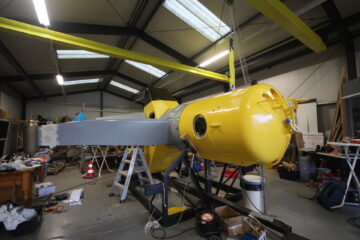
The Mobula® turbine will operate in slow-moving currents and spin at just 3-4 rounds per minute. In perspective, existing evidence from tidal energy, which operates at significantly higher speeds, reports no documented cases of marine mammals colliding with operational turbines globally[ii]. Fish interactions near turbines have shown no obvious harm[iii]. For ocean current devices operating at lower speeds, risks are expected to be even lower.
“Field data from marine renewable energy projects guide how we design, deploy, and monitor our Mobula® turbines,” said Elina Douma, Marine Environmental Expert at EQOT. “The industry has moved from hypothetical risk models to empirical evidence.”
Environmental planning from day one
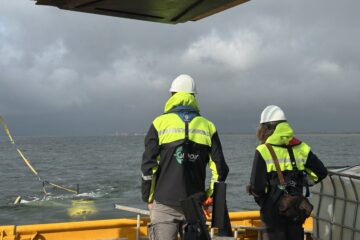
Operating with an environmental mindset is not an afterthought at EQOT; it is built into every decision, from material selection to site choice to deployment design. Every individual site we will work at will have a comprehensive Environmental Impact Assessment, baseline monitoring, and an adaptive management plan in place before anything enters the water.
“Adaptive management is not only an environmental safeguard; it is a core risk mitigation strategy,” says Pieter de Haas, Founder and CEO at EQOT. “Continuously monitoring, assessing, and adapting allows us to be proactive.”
Environmental planning is embedded across three dimensions:
1. Site selection: Projects are located using ecological sensitivity mapping, avoiding critical habitats and migration corridors where possible.
2. Engineering design: Turbine geometry, rotational speed, and material selection are optimized to minimize ecological interaction and long-term environmental footprint.
3. Deployment methodology: Installation techniques are selected to reduce seabed disturbance and localized ecosystem disruption.
In addition, building partnerships with local universities, research institutions, and coastal communities is central to our approach. This ensures continuous refinement of environmental models and accelerates collective learning across the sector.
The investment opportunity
Environmental performance is a gating factor for permitting and deployment across global markets. By aligning with internationally recognised frameworks such as OES-Environmental, EQOT is positioned to accelerate permitting processes, increase predictability in project timelines, and strengthen stakeholder and community engagement.
Ocean current energy occupies a distinct position within the renewable landscape:
- Predictable generation profiles compared to wind and solar
- High capacity factors in suitable current systems
- Minimal visual and land-use footprint
“When it comes to our technology and environmental management, we’re ready to move fast,” Pieter de Haas continues. “Securing the right new investors and local partners, Equinox Ocean Turbines can transform ocean current energy in the United States, Japan, and South Africa.”
From emerging technology to investable infrastructure
Ocean current energy is transitioning from experimental deployments to early-stage commercialization. At EQOT, we have evolved the environmental risk profile from uncertainty to proactive and evidence-backed adaptive management. A combination of data, design, and discipline is turning a previously uncertain domain into a credible, strong investment opportunity.
Sources:
[i] OES-Environmental, State of the Science Report: Environmental Effects of Marine Renewable Energy Development Around the World, 2020. https://tethys.pnnl.gov/publications/state-of-the-science-2020
[ii] Copping, A. E., Hemery, L. G., Overhus, D. M., Garavelli, L., Freeman, M. C., Whiting, J. M., Gorton, A. M., Farr, H. K., Rose, D. J., & Tugade, L. G. (2020). Potential Environmental Effects of Marine Renewable Energy Development—The State of the Science. Journal of Marine Science and Engineering, 8(11), 879. https://doi.org/10.3390/jmse8110879
[iii] Viehman, H.A., Zydlewski, G.B. Fish Interactions with a Commercial-Scale Tidal Energy Device in the Natural Environment. Estuaries and Coasts 38 (Suppl 1), 241–252 (2015). https://doi.org/10.1007/s12237-014-9767-8